
Ascendo Pte Ltd
- Address: 85, Playfair Road #06-02 Tong Yuan Industrial Building Singapore 368000
- Tel: +65 6741 1218
- Email: sales@ascendo.com.sg
© 2026 Ascendo Pte Ltd. All Rights Reserved. Website By Creative eWorld Pte Ltd.


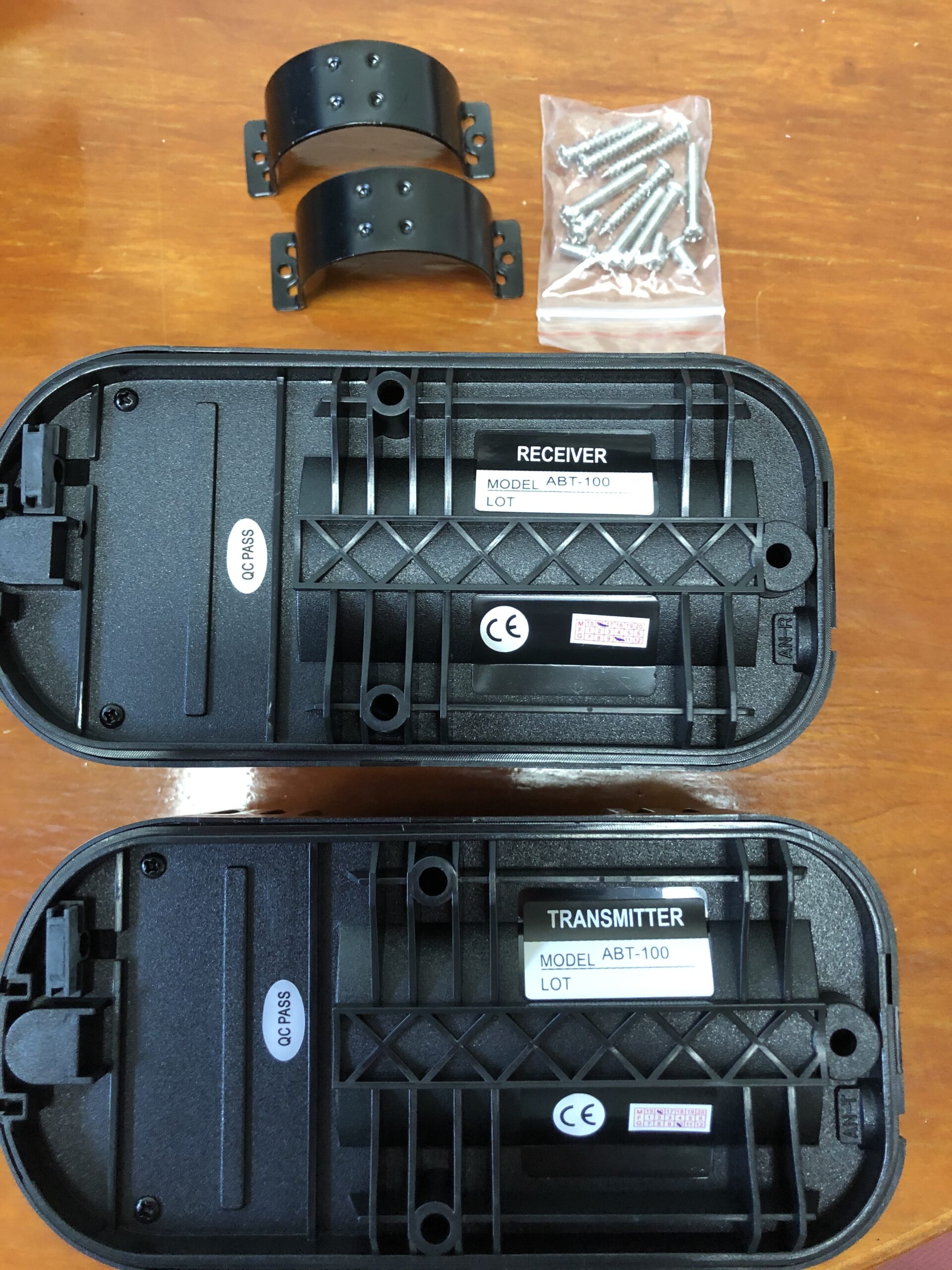
The ABT-100 monitors a straight line between two points. At a warehouse driveway, for example, the transmitter sits on one side of the entrance and the receiver faces it from the other. Two pulsed infrared beams span the opening. A person can walk alongside the driveway without crossing either beam; the detector responds when both paths are blocked together for the set time.
How to read the range: Measure from the intended transmitter position to the receiver position. For a gate entrance, that means the distance between the two mounting points. The rating describes that single span, rather than a coverage radius around either unit.
| Detection | |
|---|---|
| Optical source | Two digitally pulsed infrared beams |
| Alarm condition | Both beams interrupted simultaneously for the selected response time |
| Response time | Adjustable from 50 to 700 milliseconds |
| Detection range | Up to 100 m outdoors or 300 m indoors |
| Power and alarm connections | |
| Supply voltage | 13.8–24 V DC or 11–18 V AC |
| Maximum current draw | 65 mA |
| Alarm output | Normally open (NO) or normally closed (NC) relay contact; rated up to 30 V AC/DC, 0.5 A |
| Tamper output | Normally closed (NC) contact; rated up to 24 V AC/DC, 0.5 A |
| Alignment and environment | |
| Horizontal optical adjustment | ±90° (180° total) |
| Vertical optical adjustment | ±10° (20° total) |
| Operating temperature | −25°C to +55°C |
| Operating humidity | 5–95% relative humidity |
| Strong-light filtering | Automatic filtering for ambient light up to 50,000 lux |
| Housing material | Polycarbonate resin |
| Weight | 2 kg per set (one transmitter and one receiver) |
| Frost and dew protection | Optional heated cover |
Start with the crossing you want to detect: the entrance to a service yard, a pedestrian approach or a straight section of perimeter. Choose two positions that face each other with a clear path between them. The optical adjustment lets the installer aim the transmitter and receiver horizontally and vertically so the beams reach the opposite unit.
For an example of someone crossing the beams, open How It Works. If you are comparing distances for a project, open Models & Range to see the other ABT models alongside the ABT-100.
The two units face each other across the entrance. The transmitter on the left sends two invisible infrared beams to the receiver on the right. Together, they monitor a straight line across the driveway. The illustration shows the same entrance before and during a crossing.
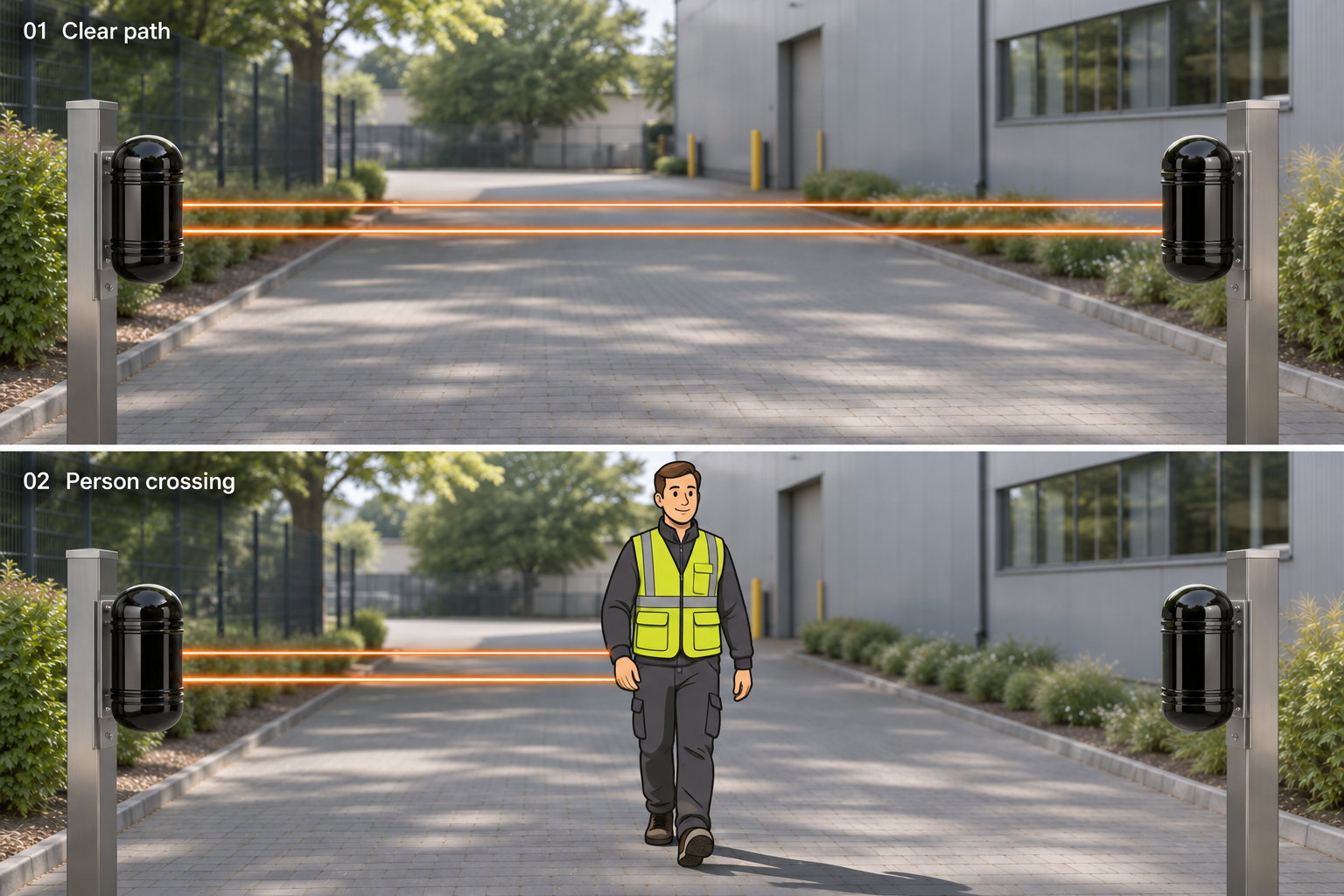
Both beams reach the receiver, so the detector remains on standby. Someone walking alongside the driveway can be close to a sensor without triggering a beam alarm, provided they do not interrupt the monitored line.
As the worker passes between the units, their body blocks both beams at the same time. If both remain blocked for the selected response time, the detector’s relay changes state and signals the connected alarm panel.
Imagine a low object interrupting the lower beam while the upper beam still reaches the receiver. That alone does not trigger a beam alarm. The ABT-100 checks for both beams to be interrupted together.
The response time sets how long both beams must stay blocked before the detector signals an alarm. It is adjustable from 50 to 700 milliseconds. For example, at a setting of 200 milliseconds, a 100-millisecond interruption is too brief. If both beams are still blocked at 200 milliseconds, the relay activates. This setting controls when the detector responds; it does not set how long a siren sounds.
Measure the straight-line distance between the two points where you plan to mount the transmitter and receiver. For a driveway or perimeter fence, use the outdoor column below. For an installation inside a building, use the indoor column. Each distance is the maximum span for one pair of sensors.
| Model | Outdoor range | Indoor range |
|---|---|---|
| ABT-20 | 20 m | 60 m |
| ABT-30 | 30 m | 95 m |
| ABT-40 | 40 m | 120 m |
| ABT-60 | 60 m | 180 m |
| ABT-80 | 80 m | 240 m |
| ABT-100 Featured model | 100 m | 300 m |
For a 90 m outdoor boundary, the ABT-80’s 80 m outdoor rating falls short. The ABT-100 covers that distance with its 100 m outdoor rating. For the same 90 m span indoors, the ABT-30 is already within its 95 m indoor rating. The distance is the same; the installation environment changes which models are within range.