

Ascendo Pte Ltd
- Address: 85, Playfair Road #06-02 Tong Yuan Industrial Building Singapore 368000
- Tel: +65 6741 1218
- Email: sales@ascendo.com.sg
© 2026 Ascendo Pte Ltd. All Rights Reserved. Website By Creative eWorld Pte Ltd.

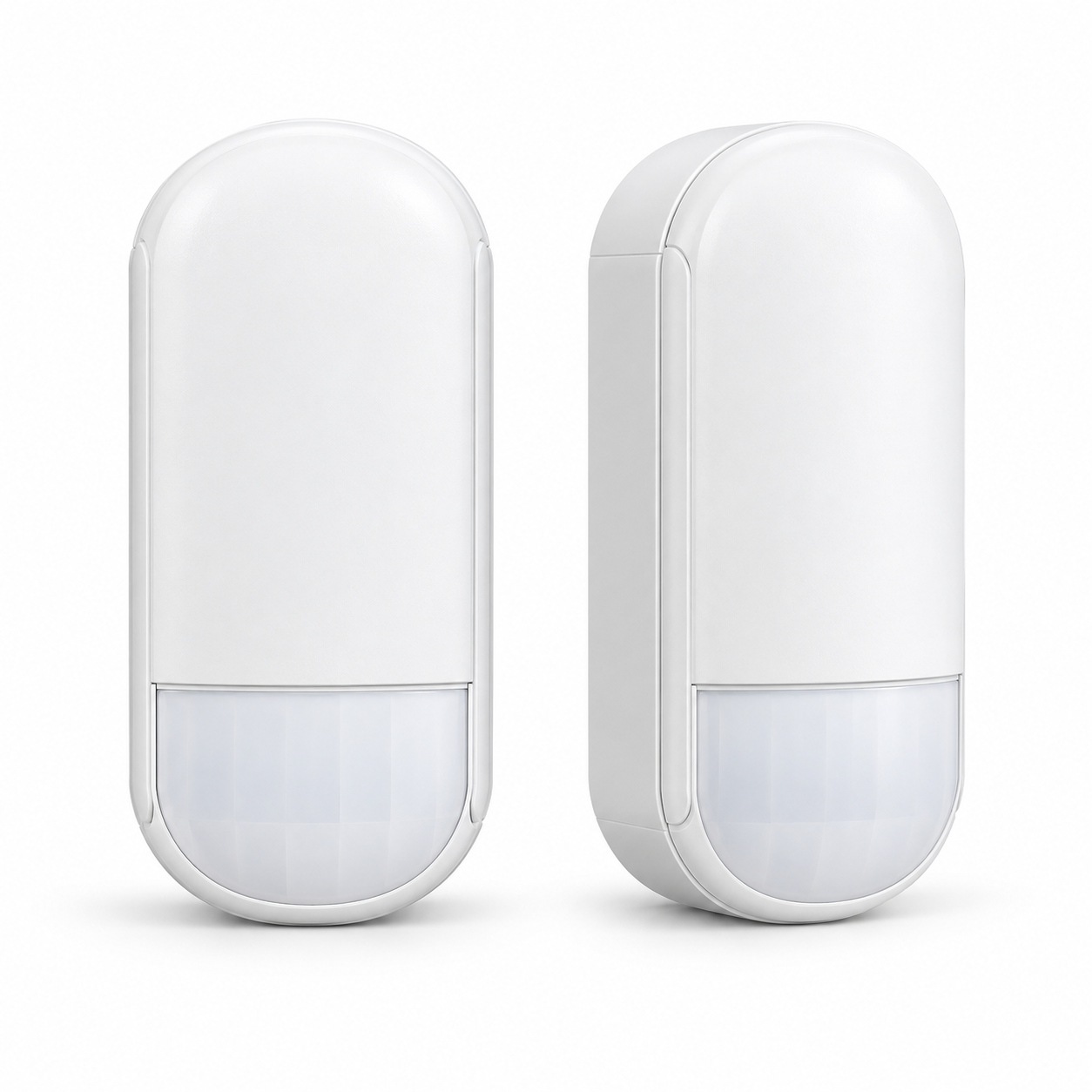
The HJ-DT12 and HJ-ST12 are indoor intrusion detectors with selectable wide or narrow detection coverage. They detect movement within the monitored area and provide an alarm output for connection to a compatible alarm control panel.
Choose the HJ-DT12 for passive infrared (PIR) and microwave detection in wide mode, or the HJ-ST12 for PIR-only detection. Both models offer flexible coverage and mounting options to suit different indoor layouts.
HJ-DT12 combines PIR and microwave detection in wide mode. HJ-ST12 uses PIR detection only.
Select a 12 m, 85° wide detection area or an 18 m, 5° narrow detection area to suit the space.
A normally closed tamper output opens when the front cover is removed, allowing a connected system to monitor cover tampering.
Suitable for wall or corner mounting. The optional CW-G2 bracket provides additional mounting flexibility, including ceiling mounting.
HJ-DT12 narrow-mode note: Microwave detection is disabled when narrow mode is selected. In this mode, detection uses PIR only.
For indoor use only. These detectors form part of an alarm system and require a compatible alarm control panel and DC power supply.
Both models offer the same selectable wide and narrow coverage. The main difference is the sensing technology: HJ-DT12 uses PIR and microwave in wide mode, while HJ-ST12 uses PIR only.
On smaller screens, swipe the table sideways to view both models.
| Feature | HJ-DT12 | HJ-ST12 |
|---|---|---|
| Detection in wide mode | PIR + microwave | PIR only |
| Detection in narrow mode | PIR only; microwave disabled | PIR only |
| Coverage options | 12 m / 85° wide; 18 m / 5° narrow | 12 m / 85° wide; 18 m / 5° narrow |
| Normal current at 12 V DC | 11 mA | 8 mA |
| Remote LED control | Available | Not available |
| Alarm and cover-tamper outputs | Normally closed (N.C.) | Normally closed (N.C.) |
Planning to use narrow mode? The HJ-DT12 disables microwave detection in narrow mode, so both models use PIR-only detection in this setting. The DT model does not provide dual-technology detection in narrow mode.
Choose this model when your installation requires PIR and microwave detection in wide mode, or when remote LED control is needed.
Choose this model when PIR-only detection meets your requirements. It offers the same coverage options with lower specified current consumption.
Swipe the table sideways on smaller screens. PIR = Passive Infrared; MW = Microwave; N.C. = Normally Closed.
| Feature | HJ-DT12 | HJ-ST12 |
|---|---|---|
| Detection method | Passive infrared (PIR) + microwave (MW) in wide mode | Passive infrared (PIR) |
| Wide coverage | 12 m, 85° | 12 m, 85° |
| Narrow coverage | 18 m, 5° (PIR only) | 18 m, 5° |
| Detection zones | Wide: 76; narrow: 12 | Wide: 76; narrow: 12 |
| Mounting height | 2.0–3.0 m | 2.0–3.0 m |
| Alarm period | 2.0 ± 0.5 seconds | 2.0 ± 0.5 seconds |
| Warm-up time | Approx. 60 seconds; LED flashes | Approx. 60 seconds; LED flashes |
| LED indicator | Green; warm-up and alarm; selectable ON/OFF | Green; warm-up and alarm; selectable ON/OFF |
| Power input | 9.5–16 V DC | 9.5–16 V DC |
| Current at 12 V DC | 11 mA normal; 14 mA maximum | 8 mA normal; 11 mA maximum |
| Alarm output | N.C.; 24 V DC, 0.1 A maximum | N.C.; 24 V DC, 0.1 A maximum |
| Tamper output | N.C.; 24 V DC, 0.1 A maximum; opens when front cover is removed | N.C.; 24 V DC, 0.1 A maximum; opens when front cover is removed |
| Remote LED control | Terminal open = OFF; 0 V = ON | Not available |
| Operating temperature | −20°C to +50°C | −20°C to +50°C |
| Temperature compensation | Super Multidimensional Analysis (SMDA) | Super Multidimensional Analysis (SMDA) |
| Operating humidity | 95% maximum | 95% maximum |
| RFI immunity | No alarm at 10 V/m | No alarm at 10 V/m |
| Dimensions (H × W × D) | 129.2 × 61.5 × 50.9 mm | 129.2 × 61.5 × 50.9 mm |
| Weight | Approx. 105 g | Approx. 90 g |
| Installation | Indoor wall or corner mounting | Indoor wall or corner mounting |
| Optional mounting accessory | CW-G2 bracket: wall, corner or ceiling mounting | CW-G2 bracket: wall, corner or ceiling mounting |
Specifications and design are subject to change without prior notice. For indoor use only. Connect to a compatible alarm control panel and DC power supply.
The HJ series monitors movement within an indoor detection area. Both models use passive infrared (PIR) sensing. The HJ-DT12 adds microwave sensing in wide mode, providing a second detection technology. When the detector registers an alarm condition, its alarm output signals a connected alarm control panel.
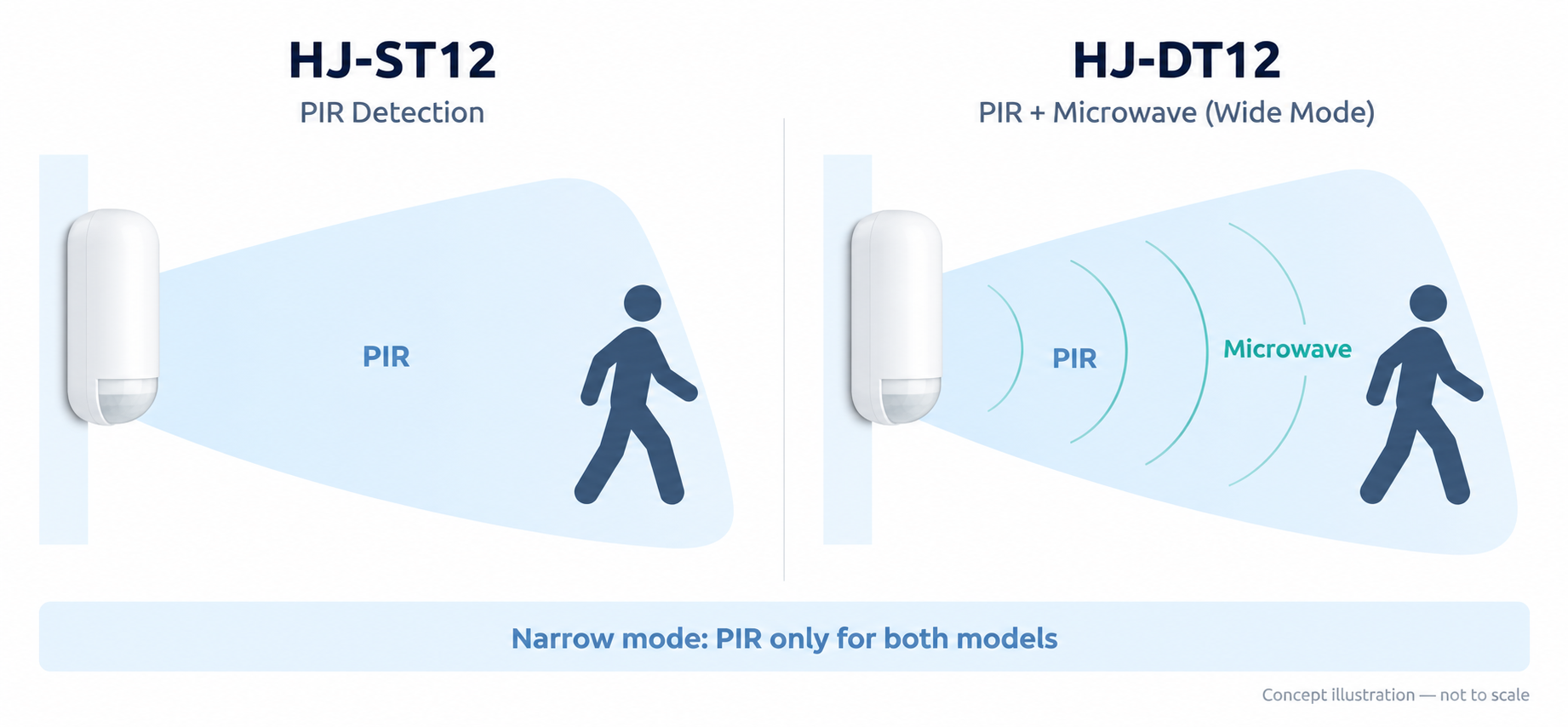
PIR detection
PIR
Senses changes in infrared energy
Movement across the detection zones changes the infrared energy received by the sensor.
Used in both wide and narrow modes
Dual-technology detection in wide mode
PIR
Infrared energy changes
+
Microwave
Changes in reflected signals
Uses two sensing technologies to monitor movement within the detection area.
Narrow mode: PIR only
HJ-DT12 narrow-mode note: Selecting narrow mode disables microwave detection. Both models therefore use PIR-only detection in narrow mode.
PIR means Passive Infrared. A person’s body emits infrared energy. As the person moves across the sensor’s detection zones, the amount of infrared energy reaching the sensor changes. The detector processes these changes to identify movement.
It is called passive because the PIR sensing element receives infrared energy rather than sending out an infrared detection beam. It does not take photographs or record video.
Simple example: A person walks across a monitored room, passing through several detection zones and changing the infrared energy received by the sensor.
In the HJ series: Both models use PIR. The lens arrangement and matching setting select wide or narrow coverage. Sensitivity settings allow the detector to be configured for the installation.
Microwave sensing actively transmits a signal and receives reflections from the surrounding area. Movement changes the reflected signal, allowing the sensor to detect motion.
This gives the HJ-DT12 a second sensing method alongside PIR: PIR responds to infrared energy changes, while microwave sensing responds to changes in reflected microwave signals.
Simple example: As a person moves within the monitored area, the microwave signal reflected back to the detector changes.
In the HJ-DT12: Microwave sensing operates in wide mode, with short- and long-range settings available. It is disabled in narrow mode. The HJ-ST12 does not include microwave sensing.
When the detector registers an alarm condition, it changes the state of its alarm output. The connected control panel then responds according to the system’s armed status and programming. These detectors are components of an alarm system; they do not contain a standalone siren.
The comparison above explains the sensing technologies; it is not a wiring or coverage diagram. Detection performance depends on correct positioning, settings and the installation environment.
The HJ-DT12 and HJ-ST12 offer two selectable detection patterns:
12 m, 85° wide coverage and
18 m, 5° narrow coverage.
Select the pattern that suits the layout and the area you need to monitor.
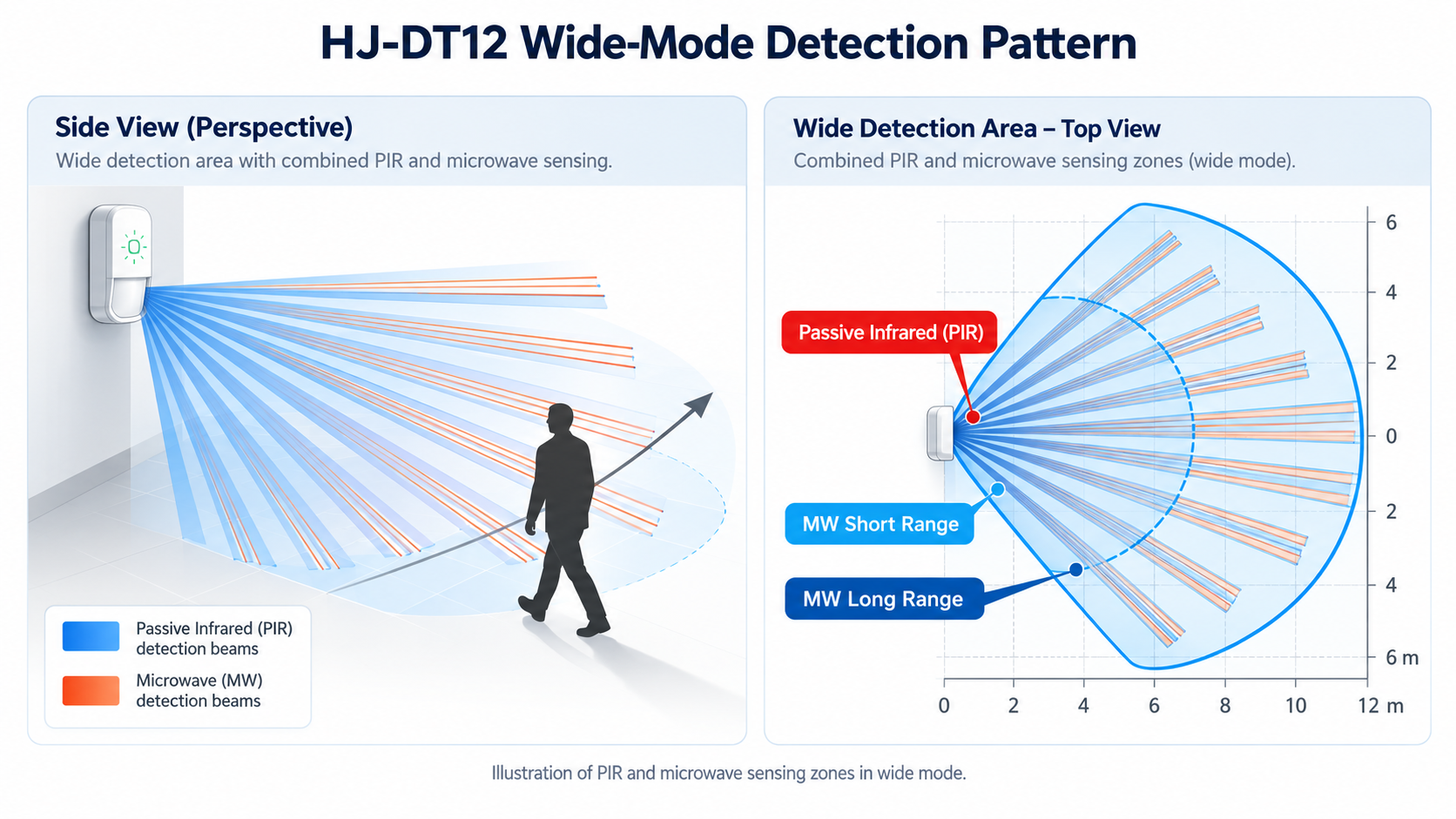
In wide mode, the HJ-DT12 combines
Passive Infrared (PIR) detection with
microwave sensing.
The illustration below shows how the PIR detection zones and
microwave sensing areas work together across the monitored space.
Important:
The diagram above applies to the HJ-DT12 in wide mode.
The HJ-ST12 uses PIR detection only. When narrow mode is selected
on the HJ-DT12, microwave detection is disabled and the detector
operates using PIR only.
Choose wide coverage for broader indoor areas or narrow coverage
for focused detection along corridors and similar spaces.
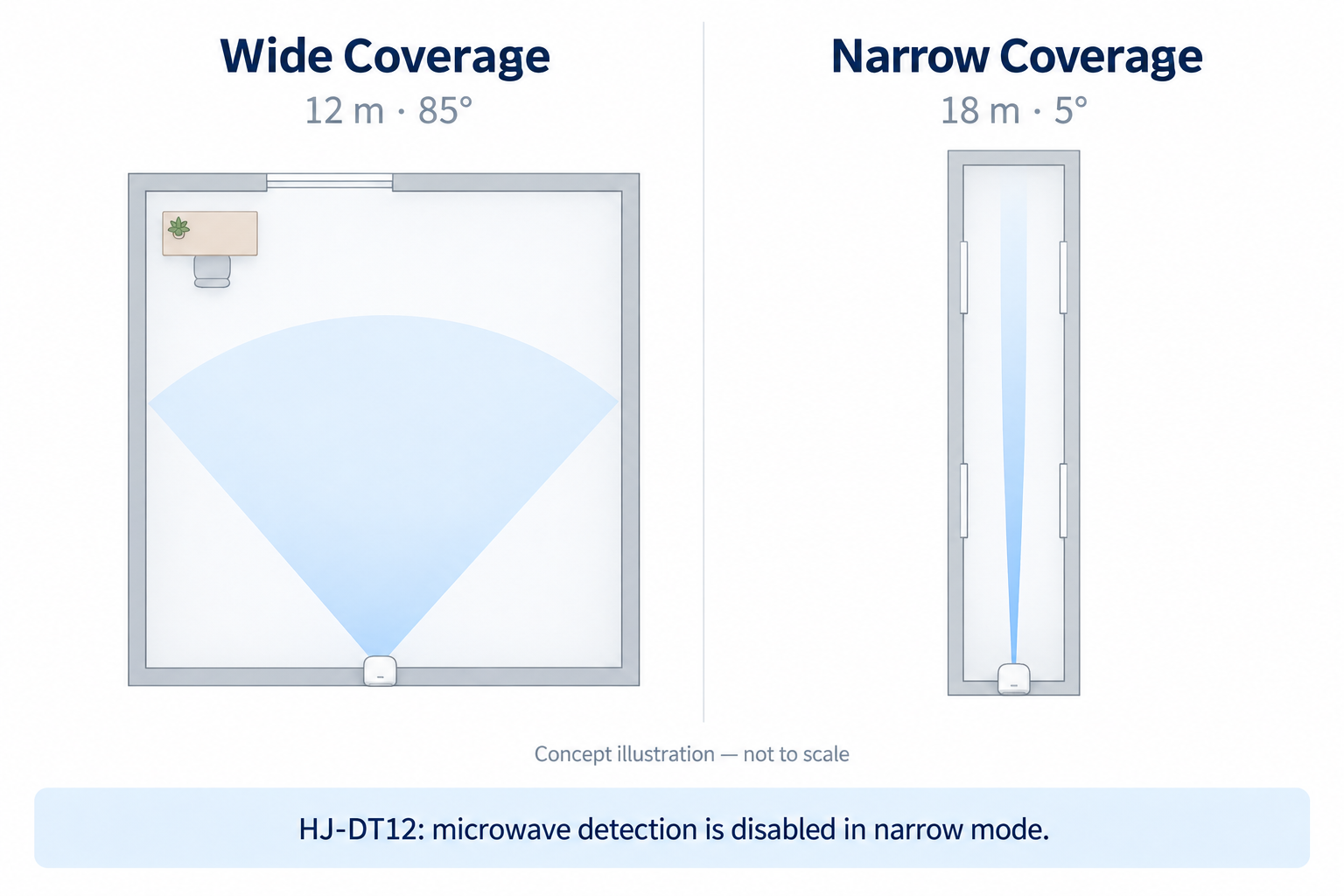
12 m · 85°
A broad detection pattern for monitoring movement across an
indoor area. Both models offer 76 detection zones in wide mode.
The HJ-DT12 uses PIR and microwave; the HJ-ST12 uses PIR only.
18 m · 5°
A focused detection pattern for a narrow area such as a corridor.
Both models offer 12 detection zones in narrow mode and use
PIR-only detection.
HJ-DT12 narrow-mode note:
Microwave detection is disabled when narrow mode is selected.
Both models use PIR-only detection in this setting.
Wide coverage can suit open floor areas where movement needs
to be monitored. Positioning should account for furniture,
partitions and the intended detection area.
Wide coverage can be considered for monitoring movement within
an indoor space. Shelving, displays and other obstructions must
be considered when positioning the detector.
Narrow coverage can suit a focused detection area along a corridor.
Correct alignment and a walk test are needed to confirm the
intended route is covered.
These are example layouts. Suitability depends on the actual environment,
mounting position, settings and alarm-system requirements.
Both models are for indoor use only.
Mount at 2.0–3.0 m above floor level;
the recommended height is 2.4 m.
Both models support indoor wall or corner mounting.
Keep the intended detection area clear of obstructions and
do not position the detector to monitor through glass.
The CW-G2 wall/ceiling mounting bracket
is an optional accessory. It provides mounting and
angle-adjustment flexibility, including wall, corner and
ceiling mounting arrangements. The detector’s specified
mounting-height range still applies.
Coverage selection uses the reversible lens and the matching
wide/narrow jumper setting.
The lens orientation and jumper must match.
Follow the product manual when configuring the detector;
selecting narrow mode disables microwave sensing on the HJ-DT12.
After installation or changes to positioning and settings,
carry out a walk test to confirm detection in the intended area.
Use the manual’s coverage diagrams when planning the installation.